 Skip to content

Rebuilding after illness involves strength, balance and confidence together. Several professions work in this building. The parts that matter for you can be combined. Assessment decides what applies. Medical care stays with your doctor.
Exercise Rehabilitation in Locust Hill After a Long Illness
Exercise rehabilitation is offered to Locust Hill patients rebuilding strength lost during months of illness or enforced inactivity. Starting points come from testing. Your physician is kept informed. Progress is recorded every visit.
Direct billing accepted with most major insurance providers




Google Reviews
5.0
"I've been seeing Dr. Karavanas for 4 years. He is the best Chiropractor in Markham."
Alex Z."I can't recommend Dr. Fiona Chan enough. She spends the entire appointment with you and always diagnoses the real cause of the issue."
Alain K."Dr. Fiona Chan is knowledgeable and patient with my kids, and has been a great support for their health and gymnastics performance."
William Y.
0 +
Years of Combined Experience
Who We Are
Rouge Park, Reesor Road and the Route West along Highway 7
Locust Hill patients follow Highway 7 west from Reesor Road and the Rouge Park lands, continuing west toward McCowan Road and the clinic entrance.
Weeks of bed rest or reduced activity strip strength at a rate that surprises almost everyone, and the recovery runs considerably slower than the decline did. Programmes start from what you can manage today rather than what you managed a year ago, with fatigue in the days afterward treated as data rather than as failure. Baseline capacity is tested gently. Post-session fatigue is recorded. Progression waits for recovery to settle. Your physician receives updates on request.
- Multidisciplinary Team
Chiropractors, physiotherapists, and registered massage therapists collaborating under one roof, so your care is coordinated, not fragmented.
- Movement Based Approach
We assess how your body actually moves, then build a treatment plan that restores function from the foundation up. Kinetic. Core. Foundation.
“Muscle disappears in weeks and returns over months.”
The asymmetry between how quickly strength is lost and how slowly it returns catches people out and leads to programmes that start far too hard. Beginning below what feels reasonable is usually what makes the following months work. Baselines are set conservatively here.
What We Offer
Exercise Rehabilitation and Recovery Care for Locust Hill Patients
Chiropractic Care

Extended inactivity stiffens the spine and hips considerably, and chiropractic care can address that restriction gently. Techniques are chosen conservatively. Findings are explained plainly.
Physiotherapy

Where pain or a specific injury limits progress, physiotherapy provides the assessment and hands-on treatment alongside the programme. Notes are shared with consent. Both plans stay coordinated.
Registered Massage Therapy

Deconditioned muscles ache readily during early training, and massage therapy can ease that ache between sessions. Pressure stays gentle. Sessions are paced comfortably. Comfort is checked.
Acupuncture

Persistent pain limiting early progress sometimes eases when acupuncture is added alongside. Points follow the assessment. Reasoning is explained first. Consent is taken each visit.
Class IV K-Laser Therapy
Localised joint pain slowing progress can be treated with Class IV laser therapy alongside the loading work. Sessions run a few minutes. Nothing invasive is involved. Training continues meanwhile.
Custom Orthotics

Walking tolerance often returns before comfort does, and custom orthotics cast on site can ease that early distance building. Gait is reviewed beforehand. Casting takes one appointment.
Exercise Rehabilitation
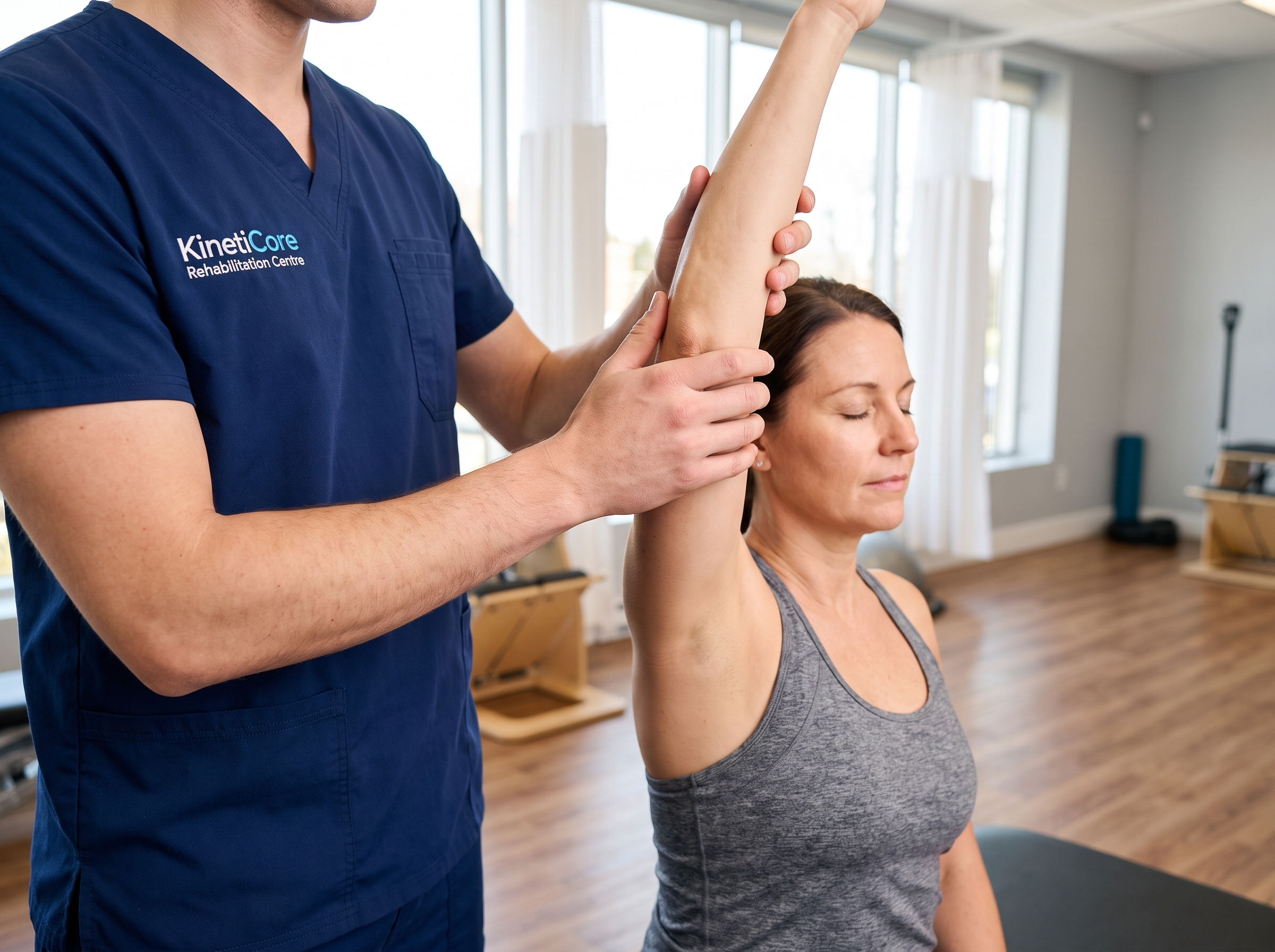
A Registered Kinesiologist under the College of Kinesiologists of Ontario sets a starting point from testing and raises load only as recovery allows. Fatigue is tracked between visits.
Pelvic Floor Therapy
Extended inactivity can bring pelvic symptoms, and pelvic floor therapy is delivered by a pelvic-health physiotherapist. A private treatment room is used. Assessment stays discreet.
Pediatric & Pregnancy Chiropractic
Family members attending together can arrange pediatric and pregnancy chiropractic, gentle low-force care for musculoskeletal comfort. Pregnancy back ache is common. Children are treated gently.
How It Works
Your Path from Pain to Lasting Movement
Every patient at KC Rehab follows the same proven four-step process, designed to uncover the root cause of your pain or restriction and build a recovery plan that actually lasts.
Step 1
Consultation and Assessment
Your first visit begins with a detailed conversation about your history, lifestyle, and goals. We then perform a hands on movement assessment to identify the underlying mechanics behind your symptoms.
Step 2
Personalized Treatment Plan
Based on your assessment findings, we build a treatment plan tailored to your specific needs, goals, and timeline. This may combine chiropractic, physiotherapy, RMT, acupuncture, and exercise rehabilitation.
Step 3
Active Treatment & Therapy
Your plan comes to life through manual therapy, targeted exercise, and the modalities best suited to your condition. Every session is monitored and adjusted based on your progress.
Step 4
Ongoing Care & Prevention
Once you have recovered, we equip you with the exercises, ergonomic advice, and maintenance schedule you need to stay pain-free and continue moving well for years to come.
Why CHoose Us
Why Locust Hill Patients Rebuild Slowly Here
Programmes start below what feels reasonable, because exercise rehabilitation after illness fails far more often from starting too hard than too easy. Fatigue is tracked between sessions. Your physician is kept informed. Progress is recorded every visit.
Starting point set from testing
Capacity is measured on the day rather than estimated from what you used to manage, which is usually a long way from where things now stand.
Fatigue tracked between sessions
How you feel in the two days after training is recorded, because that response decides whether the next session moves up or holds.
Physician kept informed
Updates can be sent to your physician on request, which matters where the illness itself is still being medically managed. You see anything sent.
Progress recorded every visit
Repetitions, weights and walking distance are written down, giving something concrete to look at during weeks that feel slow. Numbers are shared with you.
RESTORE. REBUILD. RECOVER.
Whether it has been a week or a decade, you do not have to keep adjusting your life around pain. Book your initial assessment at KC Rehab today and find out what real, movement based recovery actually feels like.
Our Customer Testimonials
Frequent Asked Questions
How quickly does strength decline with inactivity?
Measurable strength loss begins within a fortnight of bed rest and accelerates in older adults.Several weeks produces a substantial deficit. Patients from Milliken are often surprised how much capacity has gone. Recovery takes considerably longer. Testing establishes the current level.
Where does a programme start after months off?
It starts wherever testing puts you, which is frequently bodyweight movements and short walking intervals.Beginning too high derails the following weeks. KinetiCore Rehabilitation Centre sets the baseline deliberately low and builds from there. Progression is faster than expected.
How is fatigue managed between sessions?
Fatigue over the following forty-eight hours is recorded and used to decide whether the next session progresses or repeats.Feeling wiped out for days means the last one was too much. Patients from Stouffville track their response in exactly the same way. Rest days are part of the plan.
Should my physician be involved?
Medical management of the underlying illness stays with your physician, and nothing here replaces that care.Updates can be sent on request. To arrange that before starting, contact us and we will organise it. Bring any relevant restrictions. Screening happens before starting. Nothing replaces medical care.
What is the drive west along Highway 7?
Highway 7 runs directly west from the Reesor Road area toward McCowan Road with no highway transfer needed.Free parking sits outside and access is at ground level. Patients from Langstaff approach the clinic from the other direction. Allow extra time at peak periods. Drop-off at the door is possible.
Is any exercise unsafe during recovery?
How often should sessions happen?
Two supervised sessions a week suits most people early on, with home work filling the gaps.Frequency drops as independence grows. The schedule is set around your energy levels rather than a standard package of visits. Attendance is reviewed regularly. Home work fills the gaps between.
When does training move to home or a gym?
Once technique is reliable and progression is predictable, most people continue independently with periodic reviews.That transition is planned rather than abrupt. A written programme goes with you, and reviews can be spaced further apart over time. Independence is the intended outcome.